UK Car Service: Chauffeur and Airport Transfer Guide
Compare UK car service options for airport transfers, hourly hire and corporate bookings, and learn how to vet operators before you book.

Your flight lands at Heathrow at 07:15 on a Tuesday. You've got a 10:00 meeting in the City, two colleagues on a later arrival, and a finance team that will ask, in three weeks, why the invoice shows two different waiting charges for the same trip. The transfer you booked three weeks ago was the easy part. What decides whether the morning works is how the booking handles the ninety minutes between wheels-down and the back seat of the car.
Most UK car service content stops at the vehicle. It shows you a Mercedes S-Class, lists some airports, and leaves you to work out the rest. That's backwards. The service you choose, the way it's booked, and what happens when the flight slips are what determine the outcome.
UK Car Service Options Compared at a Glance
A UK car service is a pre-booked, chauffeur-led journey, and the right option depends on the shape of the trip rather than the badge on the bonnet. Match the service to the day and the rest follows. Mismatch it and you pay for flexibility you never use, or you reach 6pm with three stops still to go and no proper plan for them.
| Service | Best for | What is included | Booking pattern |
|---|---|---|---|
| Airport transfer | Arrivals on a fixed flight | Flight tracking, terminal meet and greet, luggage help, complimentary waiting from actual landing | Pickup tied to the flight number |
| City-to-city | Direct journeys between any two UK locations | Point-to-point route with the journey quoted before booking | One journey, one pickup |
| Hourly hire | Multi-stop days and changing routes | Dedicated chauffeur for the booked period, with overrun charged | Booked by the hour |
| Corporate account | Businesses with several travellers | Centralised booking, live tracking, one monthly invoice split by cost centre | Ongoing account with no contract |
| Event transport | Weddings, conferences and exhibitions | Multi-vehicle coordination and a single point of contact | Planned around the event schedule |
| Private jet arrival | Passengers flying privately | Meeting at the handling agent at Farnborough, Biggin Hill, Luton or Stansted | Pickup tied to the aircraft arrival |
Four vehicle classes cover the main choices on the network:
- Business Class: Mercedes E-Class, BMW 5 Series or similar. The default for single travellers and airport runs.
- First or VIP: Mercedes S-Class, BMW 7 Series or similar. More rear legroom, quieter cabin, used when the journey is part of the impression.
- Executive MPV: Mercedes V-Class or similar, seating six. The practical answer for families, small teams and heavy luggage.
- Luxury: Range Rover, Mercedes-Maybach or similar. Chosen for presence or for a specific passenger requirement.
Do the arithmetic before you compare anything else. Count passengers, count suitcases, then look at services. A party of five with four large cases will not travel comfortably in an S-Class, however good the rate looks. Operators set their own prices and you see the total before you confirm, so once the vehicle is right, the comparison is straightforward. Our breakdown of how chauffeur pricing works explains what sits inside a quote and what sits outside it.
Choosing Hourly, Point-to-Point or Airport Transfers
Choose by the shape of the day, not by the vehicle. That single rule resolves most of the decisions people get wrong.
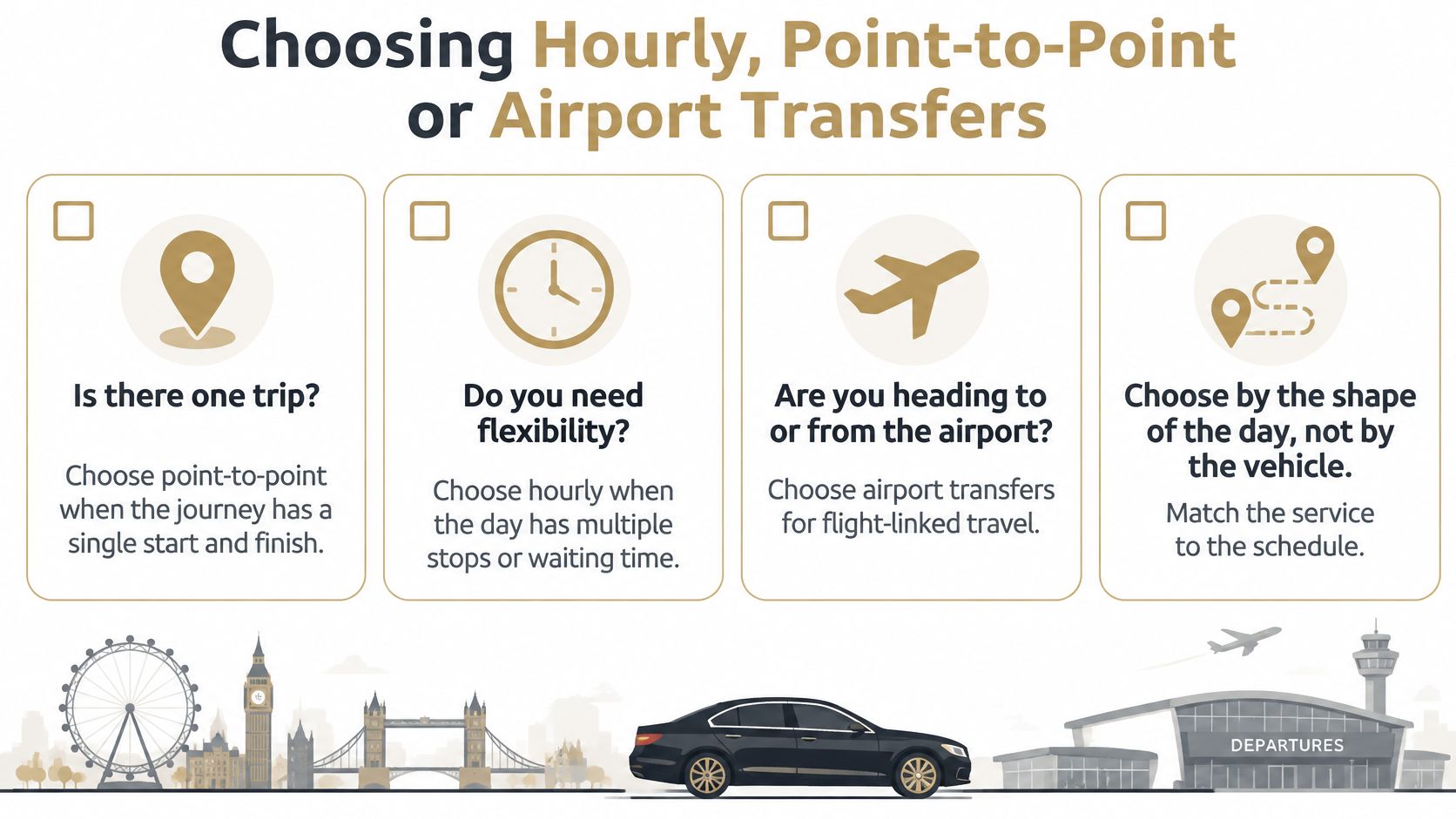
Work through these five questions in order. Each one points to a service.
- Is there one trip between two fixed points? Book point-to-point. The price is quoted before you book and holds regardless of traffic, route changes or journey time. A slow motorway costs the driver, not you.
- Does the arrival depend on a flight? Book an airport transfer. Flight tracking, terminal meet and greet, and waiting time for immigration and baggage collection are built into the booking, not added as extras.
- Are there several stops, meetings or route changes through the day? Book hourly hire. A dedicated chauffeur stays with you for the entire booking, with unlimited stops and the freedom to change the route mid-afternoon. The minimum is 2 hours. Hourly chauffeur hire is available in London, central Birmingham and Manchester, and for trips elsewhere in the UK you submit the journey and the platform looks for a driver.
- Are several people travelling to one event? Book event transport, where multi-vehicle coordination and one point of contact replace a spreadsheet of separate bookings.
- Do the same people travel every month? Open a corporate account and stop rebuilding the same journey from scratch each time.
Three tie-breakers settle the close calls. Passenger count matters because the Executive MPV seats six and a saloon doesn't. Luggage volume decides whether an MPV is necessary even for two people. And whether the chauffeur needs to wait decides between a fixed journey and an hourly booking. Inside the booked hours, waiting is already covered. If the day runs long, additional time is calculated from recorded usage at the rates shown on your quote, then itemised and confirmed to you. You see the arithmetic before you pay it, which is exactly how a booking should handle a day that doesn't go to plan.
The rule that prevents the most problems: if any part of the day is uncertain, book the hours rather than the journey. A fixed pickup assumes the schedule holds. An hourly booking assumes it won't, and charges only for the time you actually use.
Take a realistic case. Two colleagues land at Birmingham on different flights, one at 09:40 and one at 11:05, and both need to be at a 16:00 meeting in the city before heading back the following morning. That's an airport transfer for the first arrival, hourly hire covering the second pickup and the afternoon, and a second airport transfer the next day. Splitting the day this way puts the flight-dependent legs on flight-tracked bookings and the unpredictable afternoon on a chauffeur who stays with the car. One booking channel, three services, one invoice.
How an Airport Transfer Runs From Landing to Drop-Off
Picture the arrival as a sequence, because that's how the operator runs it. Knowing the order tells you where the risk sits and what you're paying for.
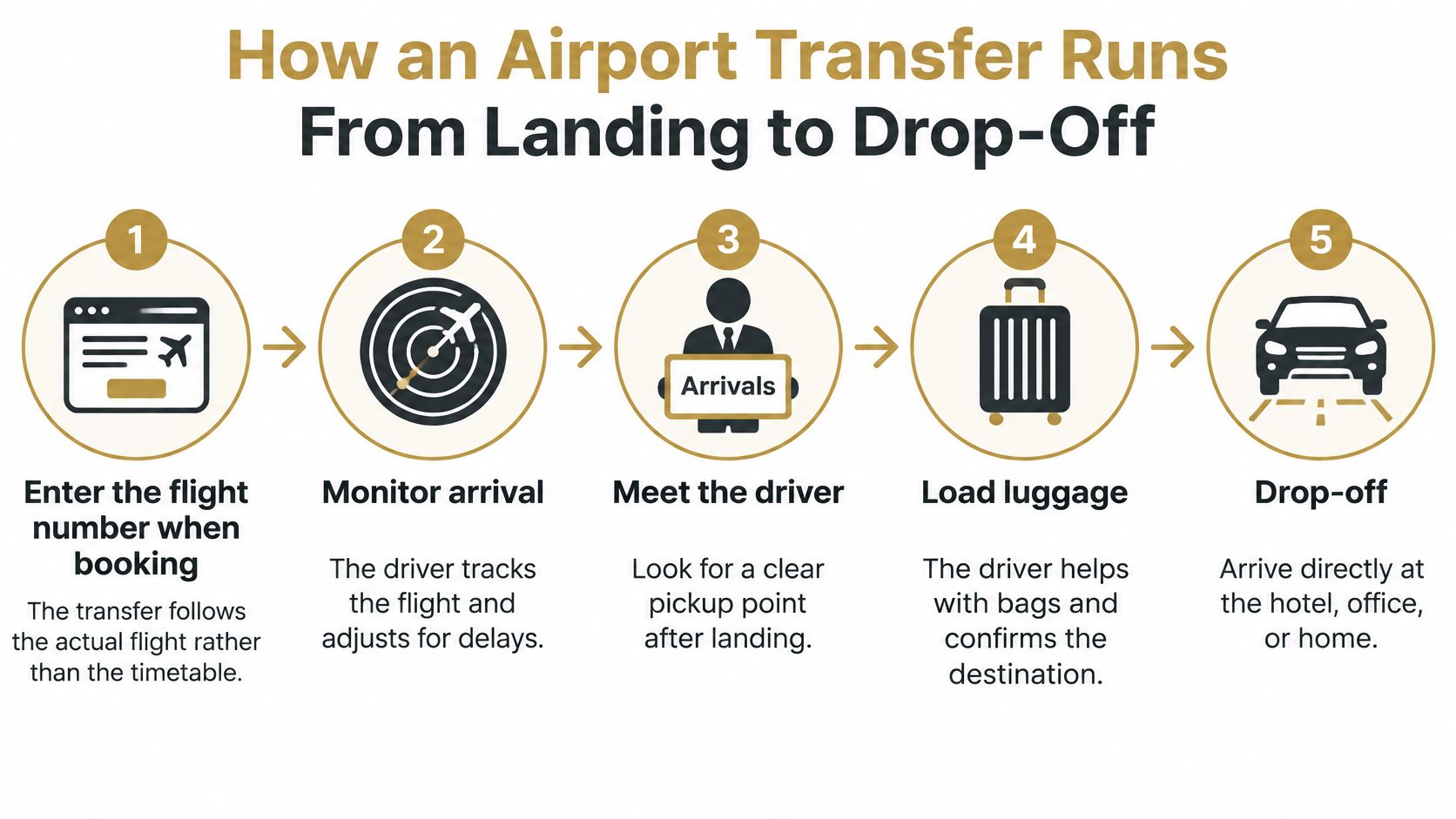
1. The flight number goes in at booking. This is the step that decides everything downstream. The transfer follows the actual flight rather than the timetable, which means the pickup moves when the aircraft moves. Skip it and you've booked a car against a guess.
2. Tracking flags the change before it becomes a missed pickup. A departure delay of forty minutes at the origin airport is visible hours before landing. The operator sees it, adjusts the dispatch, and you don't spend the flight wondering whether anyone is waiting.
3. The chauffeur meets you inside the terminal. Not at the kerb, not in a car park across the road. Inside arrivals, at the agreed meeting point, with your name.
4. Immigration and baggage collection are covered. Complimentary waiting runs from the actual landing time, so a slow queue at border control or a bag that arrives twenty minutes after the rest doesn't cost you the transfer. That buffer exists precisely because those delays are normal, not exceptional.
5. Luggage is handled and you're escorted to the vehicle. The chauffeur assists with bags and walks you out. On a wet February morning at Manchester, that difference is worth more than it sounds.
6. The journey runs on the booked route, and the chauffeur confirms it. Any change to the drop-off is agreed before the car moves, not negotiated at a set of traffic lights.
7. The journey is logged. Corporate bookers can match each completed trip to its booking, which matters at month-end when finance asks which cost centre paid for what.
The airports covered include Heathrow, Gatwick, Stansted, Luton, London City, Birmingham, Manchester and Edinburgh, so check your own arrival airport before you read further.
A good arrival is unremarkable. A greeting in the terminal, bags already moving, and a clear run to the first appointment with twenty minutes in hand.
That ordinariness is the product. It's also the thing that disappears first when a booking is made without a flight number attached.
Handling Late, Cancelled and Diverted Flights
Here's the principle that most airport transfer pages avoid: flight tracking shows that the arrival has changed, but the booking decides who pays for the extra time. Those are two different things, and only the second one generates arguments.
UK airport disruption is routine. Civil Aviation Authority data records 302 million terminal passengers at UK airports in 2025, and with volumes at that level, delayed and re-timed arrivals are part of normal operations rather than rare exceptions. A pickup fixed rigidly to the original timetable will create avoidable waiting on a large share of arrivals. Updating the flight number early is the cheapest fix available, because the pickup then follows the flight rather than the schedule you booked weeks ago.
| Situation | What changes | What to do |
|---|---|---|
| Flight delayed | Waiting is measured from actual landing | Update the flight number so the pickup follows the new arrival |
| Flight cancelled and rebooked | Arrival time and possibly the airport change | Enter the new flight and confirm the revised pickup in the booking |
| Flight diverted | Arrival airport changes | Tell the operator the new airport; extra distance is charged on recorded usage at the quoted rate |
| Early arrival | Pickup may need to move forward | Ask the operator to confirm an earlier pickup before you land |
| Terminal changed | Meeting point moves | Update the terminal in the booking and confirm the meeting point |
| Baggage collection delayed | Waiting time runs longer | Complimentary waiting covers the agreed period; additional waiting is charged on recorded usage |
Extra charges work on recorded usage, never estimates. Additional waiting, a diversion, or an extra stop is calculated at the same rates shown on the quote, itemised, and confirmed to you. No surge multiplier appears at the end of the journey because the traffic was bad.
Take the diverted flight as the hardest case. The plane lands at a different airport, the drive is longer, and somebody has to accept that cost. If the change is recorded in the booking at the quoted rate before the car moves, the invoice explains itself. If it is agreed verbally at the kerb, it becomes a dispute.
Who decides when disruption costs money? The traveller or travel manager updates the booking. The operator records the change. The invoice shows the reason for each line. Nobody reconstructs it from memory three weeks later.
That division of responsibility is what a corporate booker should test when comparing providers. A flight-tracking feature is easy to advertise. A documented decision trail is the thing that survives an expenses audit.
Corporate Accounts and Consolidated Monthly Billing
Domestic business travel is routine for many UK organisations, and the journeys themselves are rarely the hard part. The hard part is the paper trail.
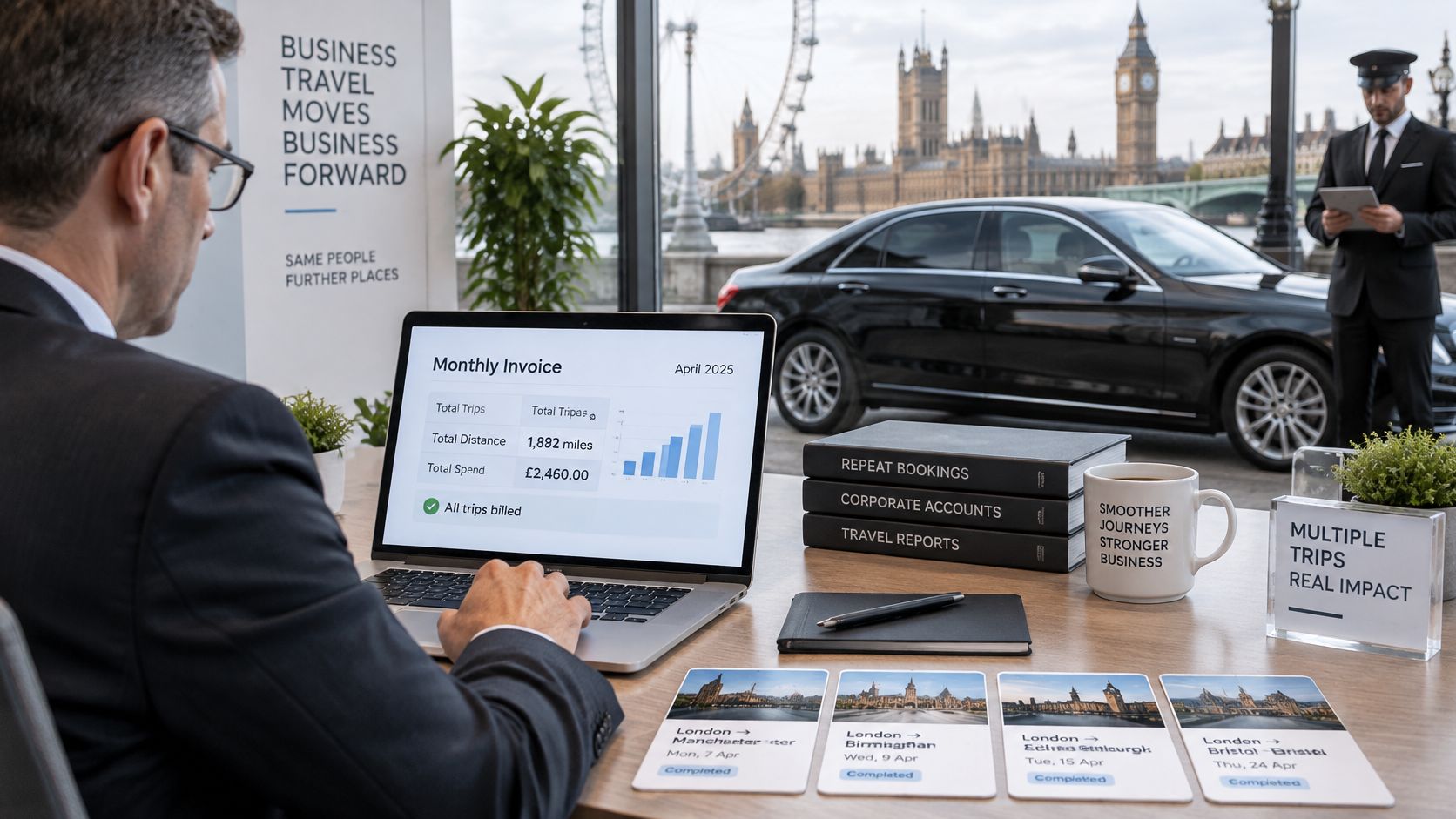
Journeys get booked by different employees, assistants and regional offices, each with their own supplier and their own receipt format. Finance receives a pile of documents that don't reconcile to a cost centre, and the travel manager ends up as an unpaid auditor. When a late flight adds waiting time or a diversion adds mileage, that decision has to survive the audit too, itemised rather than reconstructed from memory.
A corporate account fixes this in four moves:
- Open the account. It's free, with no contract and no minimum spend, so there's no procurement cycle to survive before you can test it.
- Book from one place. Every assistant and every office uses the same channel, comparing live quotes from vetted operators, so the booking record is consistent by default.
- Track bookings live. The travel manager sees journeys as they happen rather than discovering them on an invoice.
- Take one consolidated monthly invoice, split by cost centre, instead of forty separate receipts.
Operationally, a vetted, available chauffeur is allocated to each journey, meets the passenger, completes the route and logs the journey. That log is what makes the invoice defensible. Extra charges are calculated only from recorded usage, at the same rates shown on the quote, and itemised line by line, so the person who approved the trip can see exactly why a disruption cost money and who authorised it.
Consider a finance team running three cost centres across London, Manchester and Birmingham. Under separate booking, the Birmingham exhibition trip gets coded to the wrong centre and someone spends a Friday afternoon correcting it. Under one account with a split invoice, the coding happens once, at booking.
Set up one account and give every booker the same route into it. A corporate account only consolidates what it actually receives.
If your organisation is writing or revising its travel rules, our corporate chauffeur policy guide covers what belongs in one.
Accessible Transfers and What to Tell Your Operator
The most misleading phrase in UK car service marketing is "accessible vehicle available". It tells you nothing about whether the specific car arriving at the terminal can take your wheelchair, your mobility aid, or the fact that you need to transfer into a seat.
The numbers explain why. Department for Transport statistics on taxis and private hire show that only 2% of licensed private-hire vehicles in England were wheelchair accessible, compared with 54% of licensed taxis. A private-hire fleet is, overwhelmingly, saloons and MPVs with a boot.
Three different things get collapsed into one word, and you need to know which you're buying:
- A wheelchair-accessible vehicle: ramps or a lift, securement points, and the passenger travelling in the chair.
- A vehicle with boot space for a folded aid: the chair folds and travels in the back, and the passenger uses a normal seat.
- A standard Executive MPV: the passenger transfers to a seat and the aid goes in the boot, if it fits.
Before you accept a quote, give the operator these six details: the dimensions and weight of the wheelchair or aid; whether the passenger transfers to a seat; whether the chair folds; the quantity of luggage; any ramp or lift requirement; and whether the aid fits without reducing passenger capacity below your party size.
Airport accessibility is a coordination problem, not a vehicle specification. Terminal assistance, the collection point, luggage handling and the car all have to line up, and the car is only one of the four.
Premium branding is not an accessibility signal. A long-wheelbase luxury saloon can be a worse choice than a properly specified MPV, because the boot is smaller and the ride height is lower.
Ask for each requirement to be confirmed in writing before you accept the quote. An operator who can't put it in writing hasn't checked.
What a Chauffeur Vehicle Service Checks Before Every Booking
A car service, in the fleet sense, is the set of checks that keeps a vehicle safe and legal on every booked journey, not just on the day it passed its MOT. The UK fleet makes that a continuous job. SMMT Motorparc data counted 41,964,268 vehicles on British roads in 2024, with an average car age of 9.5 years and 43.4% of the car parc more than 10 years old. Older cars stay in service, so the operating check has to be repeated, dated and assigned to someone who can act on it.
The MOT record shows what happens when checks lapse. Brake's analysis of government MOT data reports that one in three cars and vans failed their initial MOT, one in five had a major defect and one in ten failed on a dangerous defect. For cars and light vans, lamps, reflectors and electrical equipment was the most common category at 14%, followed by suspension at 10%. That is the baseline a chauffeur service should be beating before a passenger ever opens the door.
Brakes and tyres deserve separate controls. DVSA MOT class 3 and 4 failure data shows brakes accounted for 16.38% of all recorded defects in 2023 to 24, with 2.64% of tests containing a dangerous brake defect, while tyres affected 6.37% of tests in the January to March 2024 quarter. A valid MOT certificate is not evidence that either will hold for the next interval.
| Control | Evidence | What to record |
|---|---|---|
| Brakes | 16.38% of recorded MOT defects; 2.64% of tests had a dangerous brake defect | Friction material, disc and caliper condition, brake-fluid condition |
| Tyres | 6.37% of tests had a tyre defect in Jan to Mar 2024; 4.88% dangerous | Tread depth, inflation, sidewalls, uneven wear |
| Lamps and electrics | Most common defect category at 14% of cars and light vans tested | Bulbs, reflectors and wiring checked and dated |
| Suspension | 10% of cars and light vans tested | Wear items and alignment condition |
| Recall status | Checked by vehicle identification number against manufacturer or government data | Recall reference and whether remedial work is complete |
Use the table as a working checklist, not a decorative summary. Brake and tyre notes should name the item checked and the condition found. Lamp and suspension checks should be dated, because a dated record tells you whether the car was inspected before this booking or months beforehand. Recall status should be checked by vehicle identification number through the GOV.UK vehicle recall service, with the recall reference and remedial work status kept with the booking file.
Under the LimoHawk Standard, vehicle age, class and condition are checked before a chauffeur company can quote on the platform, and the 72 checkpoints cover the operator's licence, insurance and chauffeur vetting. That is the right split of responsibility: the operator maintains the vehicle, the platform checks the operator before quoting, and the customer gets a clear basis for choosing between cars.
Vet the Operator and Book Your Next Transfer
Private-hire bookings should be made with a licensed operator. Check the operator licence before you book, because it tells you who is legally responsible for supplying the journey. Skip any service that cannot name the operator clearly.
A managed marketplace should do that checking once, on your behalf, rather than leaving every client to repeat it. Every chauffeur company on LimoHawk passes 72 quality checkpoints before it can quote, across categories that include:
- A valid private-hire or PSV operator licence, verified rather than self-declared.
- Verified insurance covering the work being booked.
- DBS-checked and background-checked chauffeurs.
- Vehicles no more than four years old, with age, class and condition checked.
- Continuous monitoring, with repeated failures leading to removal from the network.
That screening matters for more than compliance. It narrows the field to operators that accept visible standards on licensing, insurance, driver checks and vehicle condition. For operators weighing up whether a managed network is worth the oversight, our explanation of vetted chauffeur operators sets out what the checks involve.
LimoHawk is the booking and payment intermediary. Independent licensed operators supply each journey. Keep that separation in mind when you read a quote, because the operator supplies the car and chauffeur while LimoHawk manages the booking record and the standard attached to it.
Then the booking itself takes under two minutes:
- Enter the pickup, destination, date and time, plus the flight number if it is an airport arrival.
- Compare vetted operators side by side, with the service type chosen from the table above.
- Check the total before you confirm. The quote you accept is what you pay, with no surge multiplier added and extra charges only for usage beyond what was booked.
- Keep every booking in one place, so the trip details are available when plans change or a cost needs checking.
Book your next airport transfer, city-to-city journey or hourly hire through LimoHawk.com and you get a vetted, licensed operator, flight tracking tied to the actual arrival, and a total shown before you confirm. Choose the service that matches the shape of your day, then keep the booking record close. That is how you avoid vague promises and make every transfer easy to account for.